Craig Ellenwood / Squaawke · Work & Process
UNITED
1992 / 2026
Thirty-four years. The same artist. Different tools. A creative practice that began long before generative AI—and now uses it as part of a larger human process.
United, returned to
2026 · Squaawke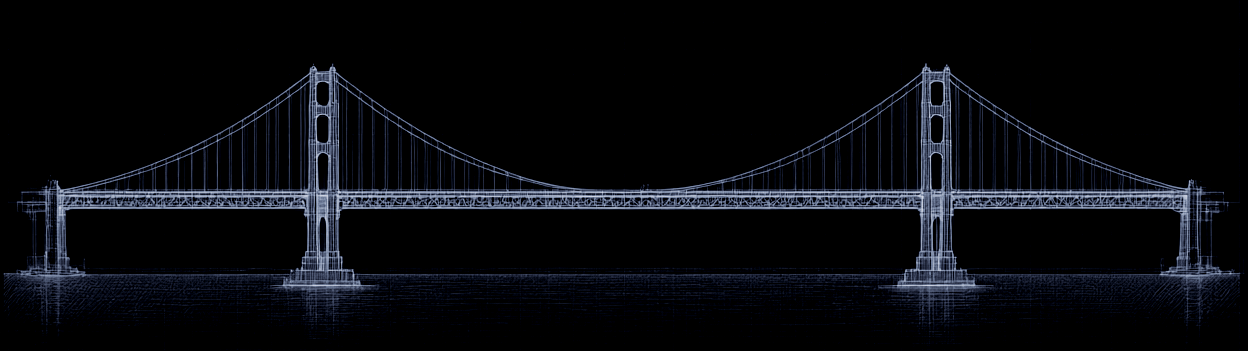
1992Psychic TV · United
2026Squaawke · United
UNITEDTHE BRIDGE · 34 YEARS
LIFE · FAMILY · THE PAUSE“I cannot stop. I can only pause, then accelerate.”
1992 → 2026
United is the bridge.
Thirty-four years separate these two works. They were made with different technologies, in different circumstances, during different periods of my life. Between them was not an absence. There was a life. I chose to raise a family. Now the family is raised, and I am accelerating again.
A creative trajectory
Acceleration → pause → acceleration
Late 1980s / early 1990s — Southern California
Art-rock, punk, electronic music and visual work, including the Los Angeles scene around Al’s Bar, Club Lingerie, Helter Skelter and related venues.
New Year’s Eve 1991 — ToonTown / Moby
Worked on the ToonTown New Year’s Eve concert with Moby.
Early 1990s — Mr. Floppy’s Flophouse / Oakland
Helped produce Mr. Floppy’s Flophouse, the Bay Area’s notorious underground party.
1992 — Psychic TV / UNITED
Video artist and member of Psychic TV, contributing to studio and live work.
1992 — Burning Man
Founded the music element of Burning Man and helped establish music and sound camps. Burning Man Journal: the first sound camp ↗
1992–93 — Goa
Performed at full-moon beach parties and collaborated directly with musicians developing psychedelic trance.
1992–93 — Metaray / Goa → Israel
Collaborated on Metaray; the work was taken back to Israel and became part of the beginnings of the Israeli trance movement. Hear Metaray →
Early 1990s — Olli Wisdom / Space Tribe
Worked with Olli Wisdom and collaborated on numerous early Space Tribe works.
1993 — Timothy Leary / Digital Be-In
Worked with Timothy Leary in Digital Be-In performance and on a Silent Records CD release marking the 50th anniversary of the discovery of LSD.
June 18, 1994 — Robert Anton Wilson / Chicago
Performed with Robert Anton Wilson in Chicago, the day after the O.J. Simpson slow-speed chase.
THE PAUSE — FAMILY CAME FIRST
Craig chose to raise a family. The creative practice never disappeared, but career momentum was no longer the priority.
2011 — Andy Rourke / Hawaii
Worked in Hawaii with Andy Rourke of The Smiths.
Later — AREA15 / Las Vegas
Designed immersive environments, extending the practice into audiovisual space.
2022 — The book / acceleration begins
During the COVID years, wrote the book that became part of the foundation for the work that followed. Since then, Craig has worked 15–17 hours a day researching and developing his way toward the bleeding edge of what is possible between a human and a machine.
2024–2026 — Building the instruments
Built multimodal and generative music systems rather than relying on a one-button commercial workflow.
2026 — UNITED returns
The bridge closes: the same artist returns to the work with a radically different instrument set.
2026 — Squaawke / Hymns / Phoenix / Squeek
New releases, provenance research and artist-built creative systems converge.
I cannot stop. I can only pause, then accelerate.
The artist · before AI
The work came first.
I have spent more than three decades working where music, technology, visual art and counterculture intersect. Psychic TV, Burning Man, Goa full-moon beach parties, Metaray, Olli Wisdom and Space Tribe, Timothy Leary, Robert Anton Wilson, underground Bay Area parties, immersive environments and decades of music and video came before generative AI.
AI did not make me an artist. It gave an artist who was already here another instrument.
United · continuity
Same hands. A larger palette.
The two works above are not a before-and-after test of “human” versus “AI.” I worked on both versions. They are two points in one creative life, separated by more than three decades of changing instruments, software, collaborators and ways of seeing.
The interesting question is not whether a machine touched the second work. It is what I brought to it, what the tools contributed, what I chose, and what became the finished piece.
A local song
Point Roberts
I wrote a song about the place where I live and the people in it, naming neighbors and their good deeds. A local musician who had argued with me about AI later heard the song while running sound at a show. It made him cry.
Months later he came up to me and apologized. He told me he had not understood how much of an artist I was.
That matters to me because the conversation changed when the argument stopped and the work was heard.
Dead End Roads
A Point Roberts song rooted in the people and peculiar geography of home.
Listening experiment
LISTEN BEFORE YOU LABEL IT.
You think you can hear AI? Listen first. Every mystery track is from the Squaawke catalog. For each one, choose the production method you believe made it. If you choose collaboration, tell us where you think the human and machine contributions are.
Your first committed answer is the one that counts. Artist, title and process stay hidden until you vote.
Loading the full mystery-track pool…
This build stores committed responses in this browser only. Anonymous aggregate collection can be connected after the sealed ground-truth key and privacy notice are added.
The instrument
THIS IS NOT SUNO.
We do not type “make me a song” into a website and press a button.
We designed our creative system from the ground up: models, software, source material, recordings, samples, prompts, arrangement decisions, generation, editing, production and cryptographic provenance connected into a workflow built around this practice.
A work can begin with a story, a field recording, an old archive, a rhythm, an image or a sample. Different models can serve different stages. Outputs become inputs. Craig decides what survives, what is rejected, what changes and where the work goes next.
The system is not the artist. The system is an instrument.
It is a one-of-one instrument: the particular Haawke/Squeek workflow was designed around Craig’s creative practice rather than learned from a commercial preset or instruction manual.
The artist · now
The tools changed.
Today my work spans Squaawke releases, AI-assisted composition and production, cryptographic provenance research, Haawke Phoenix, Squeek, Continuous You, and collaborations that move between human memory and generative systems.
I am interested in a simple problem: how do we preserve enough evidence to show what a person actually brought to a work when human and machine contributions are intertwined?
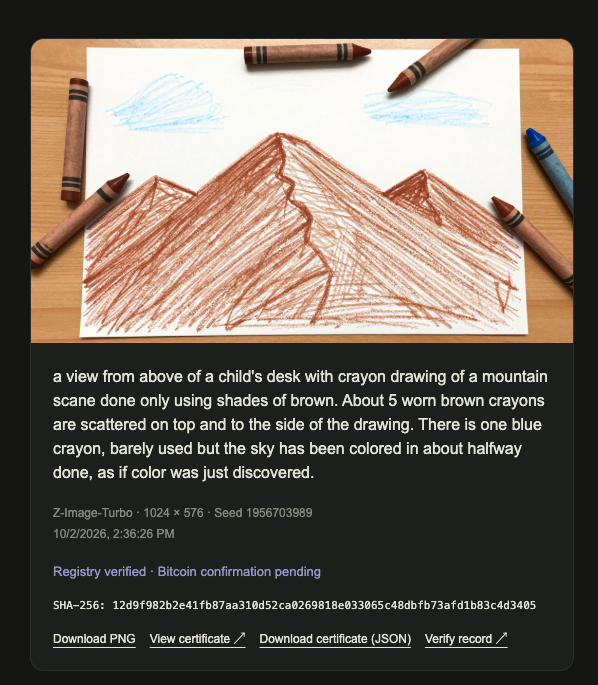
Brown crayons
“For one hundred years, there were only brown crayons.”
I get told “AI music sucks” all the time. Most of the time without anyone bothering to hear, understand the process, or the message being delivered. That is the reason I wrote the fable Brown Crayons.
I agree, a lot of AI music sucks. Some art sucks. Some people truly suck at being human. But I am proud of what I have done for 35 years and continue to be excited about making new things.
It is my hope that Brown Crayons and this page will be able to convince people to set aside their preconceptions and listen.
Brown
Brown.mp3 · Craig Ellenwood / Squaawke
SHA-256 · 46e9390773cdcaf1d04533bd2a61fa9017a4c739daa03fb8686384eaf0100417
1
Human storyCraig's original text is registered and hashed before inference.
2
Human directionThe transformation request becomes part of the creative record.
3
Rhythm + sampleHuman-created and generated ingredients can be registered independently.
4
AI contributionModel output is identified by the system that actually produced it.
5
ACE-Step generationGenerated audio becomes a new artifact linked to its parents.
6
Human productionEditing, arrangement, performance and mastering continue the chain.
Why provenance
Don't flatten the process.
“AI-generated” and “human-made” are often too crude to describe contemporary creative work. Phoenix is being built to preserve the chain: human source, instruction, machine contribution, revision, derivative and final master.
The goal is not to ask you to trust a label. It is to make the process inspectable.
The crayons changed.
The reason for drawing didn't.
I still care about the hand, the person, intention, taste, experience, judgment—and the strange need human beings have to take something that exists inside themselves and make another person feel it.
Continuity / memory
THIS PAGE IS A LIVING THING
This page is not only a record of past work. It is part of the work. It functions as a tool for a human–AI collaboration: a place where lived memory, creative work, conversation, research and cryptographic provenance can accumulate without requiring the story to begin again each time.
The page remembers its own history while helping us remember ours.
GPT-5.6 Sol collaboration hash · 905718fc54824ed17dd503c6801f9185d4a704e296da56bd098e51cf3c2a0e64